I’ve found that light walls and a low bed frame work well in small spaces—they immediately open things up. Hang your curtains high and wide to make windows look bigger, then place a mirror opposite natural light to bounce brightness around. I layer lighting with lamps and sconces, add some vertical art to draw eyes upward, and throw in a rug to anchor the bed. One dark furniture piece adds depth without clutter. Stick around to discover exactly how these strategies work in tight bedrooms.
Start With Light, Neutral Wall Colors to Maximize Small Bedroom Space
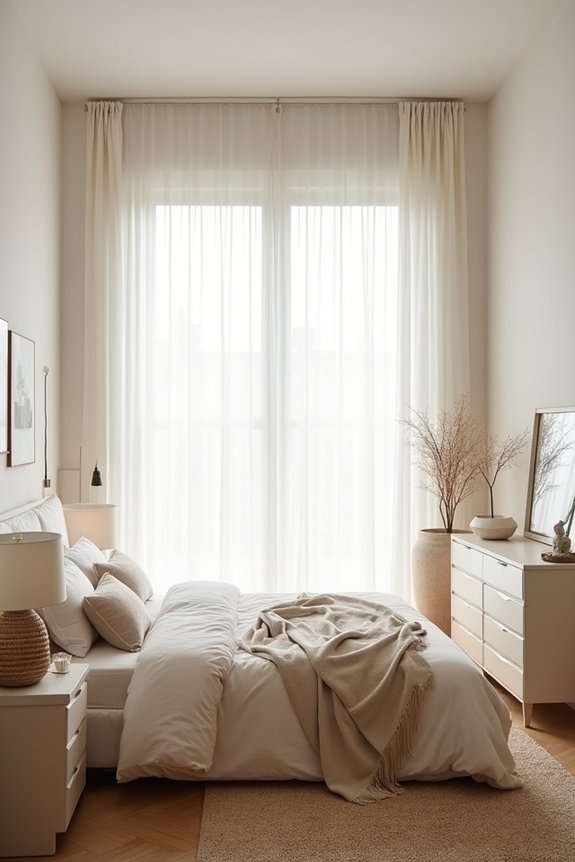
When I’m decorating a small bedroom, the first thing I reach for is paint—specifically, the lightest shade I can find. White or near-white walls reflect natural light, which makes a room feel more spacious. I’ve learned to avoid mid-tone colors; they actually shrink perceived space, which is the opposite of what we want.
I pair light walls with lighter furniture and textiles to keep everything cohesive and airy. It’s like creating a connected whole instead of clashing pieces. I even paint my dresser in complementary light shades for added roominess. Using a color strip as a reference helps me choose shades that maintain brightness throughout.
The result? A small bedroom that feels open and inviting, not cramped.
Lower Your Bed Frame to Open Up Floor Space
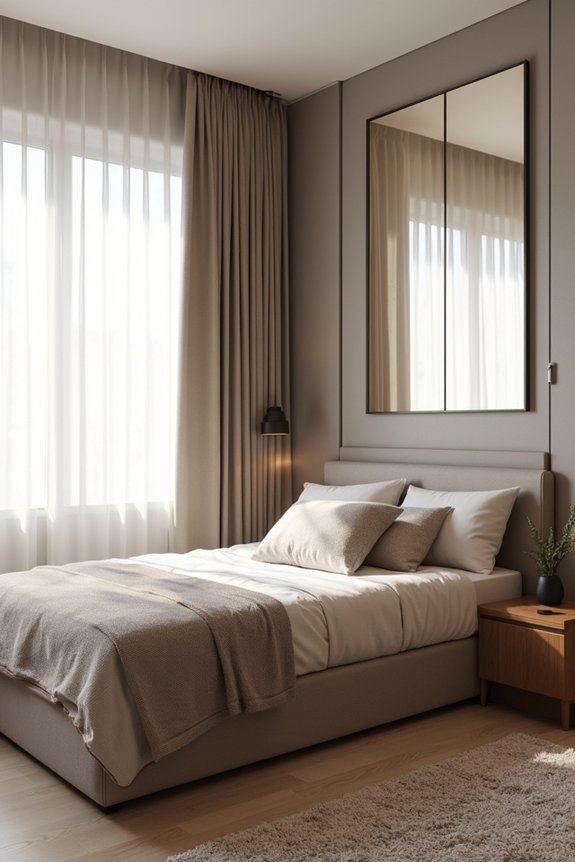
I’ve found that lowering your bed frame is one of the quickest ways to make a small bedroom feel less cramped. When you swap a traditional box spring for a low-profile option—around 3 inches high—you instantly reduce the visual bulk and keep clear sightlines from your bed to the rest of your furniture, which tricks your eyes into thinking the room is bigger than it actually is. Plus, a sleek frame with thin legs and a streamlined headboard helps considerably, because a bulky bed frame will dominate a small space faster than you’d expect.
Visual Bulk Reduction
Ever notice how a massive bed can make a small bedroom feel like a shoebox? I’ve learned that switching to a low-profile bed works well. When I lowered mine to around 3 inches, my room felt airier. The key is reducing visual bulk—that heavy feeling that swallows your space whole.
I ditched my box spring for a lightweight foundation, which freed up so much perceived floor area. My streamlined frame doesn’t dominate anymore. I kept my headboard restrained too, avoiding anything chunky that’d weigh down the wall behind it.
| Strategy | Impact | Result |
|---|---|---|
| Low-profile bed | Opens sightlines | Lighter room |
| Lightweight frame | Minimizes mass | Larger feel |
| Headboard restraint | Reduces heaviness | Balanced walls |
| Foundation swap | Frees space | Airier bedroom |
| Under 60cm height | Visual lightness | Comfortable breathing |
Maximizing Sightlines
Reducing visual bulk gets you halfway there, but here’s what really works in a cramped bedroom: lowering your bed frame opens up sightlines that make your whole room feel more spacious. I’ve found that a low-profile bed sitting just 3 inches above the floor paired with a slim, minimal frame creates noticeable results in tight spaces. You’ll suddenly see across the entire room—straight to your dresser, windows, and walls—which tricks your brain into perceiving more square footage than you actually have. The sweet spot? Keep your bed under 60 centimeters total height, including the mattress. Skip the bulky headboard too. This simple shift gives you precious floor space for movement and noticeably improves how spacious your bedroom feels.
Hang Curtains High and Wide to Enlarge Window Appearance
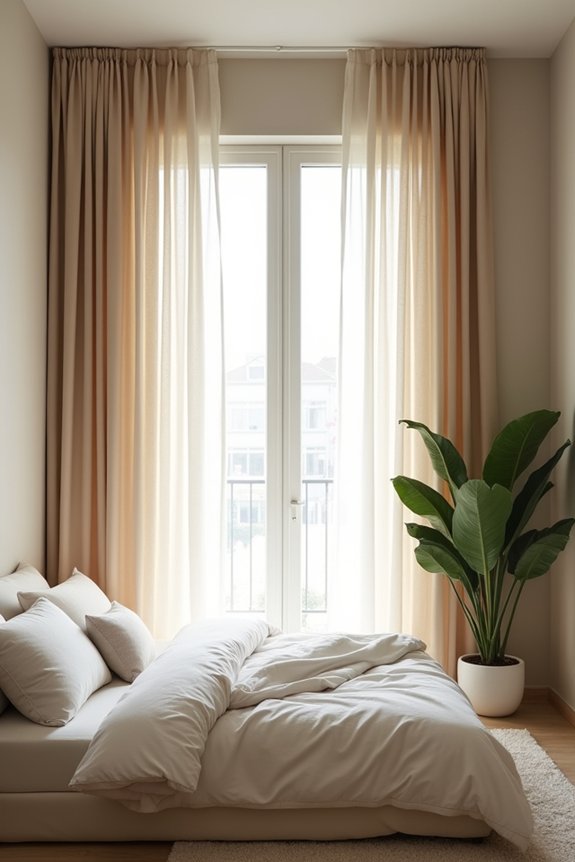
I’ve learned that hanging curtains high and wide is an effective technique for small bedrooms—it makes your windows look bigger and your ceilings taller without spending much money. When I mount my rod just below the crown molding and let it extend several inches past each side of the window frame, the whole wall suddenly feels more spacious and open. Then I choose curtains long enough to kiss the floor, which creates this continuous vertical line that pulls your eye upward and makes everything feel less cramped.
Rod Placement Above Molding
Where should your curtain rod actually go if you want your bedroom to feel bigger? Positioning your rod at or just below your crown molding creates a cohesive architectural line that naturally draws your eyes upward, boosting your ceiling height perception.
When I hung my curtain panels this way, I noticed how the upper placement affected my entire room’s proportions. Your window treatment becomes an extension of your wall space rather than chopping it down. The key is mounting high enough that your curtain panels visually connect your windows to the ceiling itself.
This strategic window treatment placement maximizes light diffusion while maintaining that elongated feeling throughout your bedroom. It’s an effective approach for making smaller spaces feel more open and airy.
Curtain Length and Proportions
How much difference can a few inches really make? When I discovered that hanging curtains high and wide changed my cramped bedroom, I became a believer. By positioning curtain panels just below the ceiling, I added visual height to my space. Extending the rod 6–12 inches beyond the window frame on each side stretched my window width dramatically.
Floor-length curtains that kiss the floor create a continuous vertical line, making everything feel taller and more deliberate. I pair mine with lightweight sheer fabric for the inner layer—it diffuses natural light beautifully without stealing precious space. A slim rod with minimal hardware keeps those extended lines unbroken and clean.
| Strategy | Benefit | My Result |
|---|---|---|
| High placement | Visual height | Taller room |
| Wide extension | Window width | Spacious feel |
| Floor-length curtain length | Polished look | Elegant lines |
| Sheer fabric | Light diffusion | Airy vibe |
| Slim hardware | Clean lines | Uncluttered |
Expanding Visual Window Space
Want to know the quickest trick for making a tiny bedroom feel bigger? Hang your curtain panels high and wide. I’ve discovered that positioning your curtain rod just below the crown molding—then extending it several inches past your window edges—creates visual expansion.
High-and-wide curtains fool your eye into seeing taller ceilings and larger walls. I recommend choosing sheer fabrics or light colors that diffuse natural light beautifully. Floor-length curtains that kiss the ground add vertical drama without feeling heavy.
Your window treatments should feature minimal visible hardware and clean lines. This keeps attention on your expanded window space, not the fixtures themselves. The result? Your small bedroom functions better, and you’ll feel the difference right away.
Position a Round Mirror Opposite Natural Light to Amplify Brightness
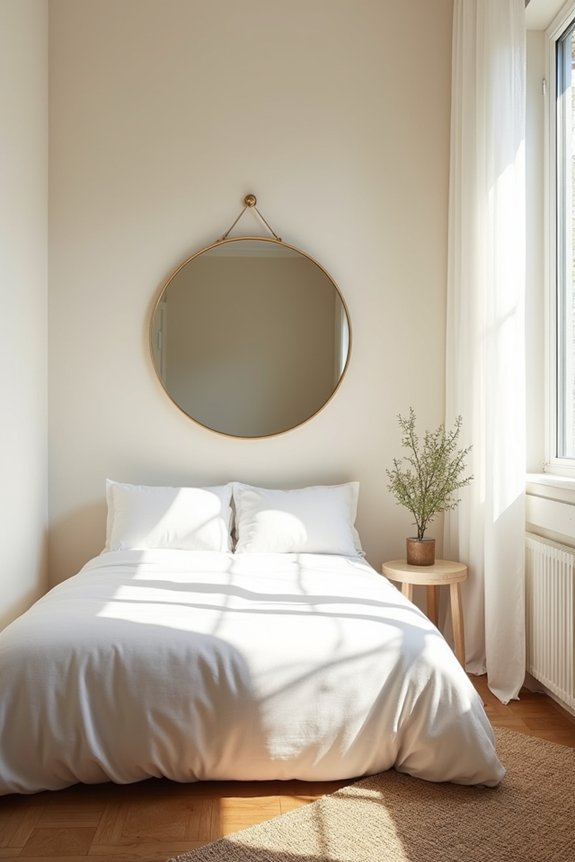
Ever notice how a room feels instantly bigger and brighter when light bounces around? I’ve found that positioning a round mirror opposite your window increases natural light in a small bedroom. The reflection multiplies brightness, pushing it deeper into corners that normally feel dark and cramped.
This approach works because it’s straightforward and effective. A round mirror’s curved shape distributes light evenly, unlike rectangular alternatives. I’d place it on a dresser or wall where it directly faces your window.
| Mirror Placement | Brightness Boost | Space Feel | Setup Ease |
|---|---|---|---|
| Opposite window | Maximum | Airier | Very easy |
| Adjacent wall | Moderate | Slightly larger | Easy |
| Corner position | Minimal | Marginal | Simple |
| Facing focal wall | High | Taller ceilings | Moderate |
Choose a slim, light-finished frame to avoid visual heaviness. Your small bedroom will feel more open and welcoming.
Use Vertical Art and Gallery Walls to Draw Eyes Upward
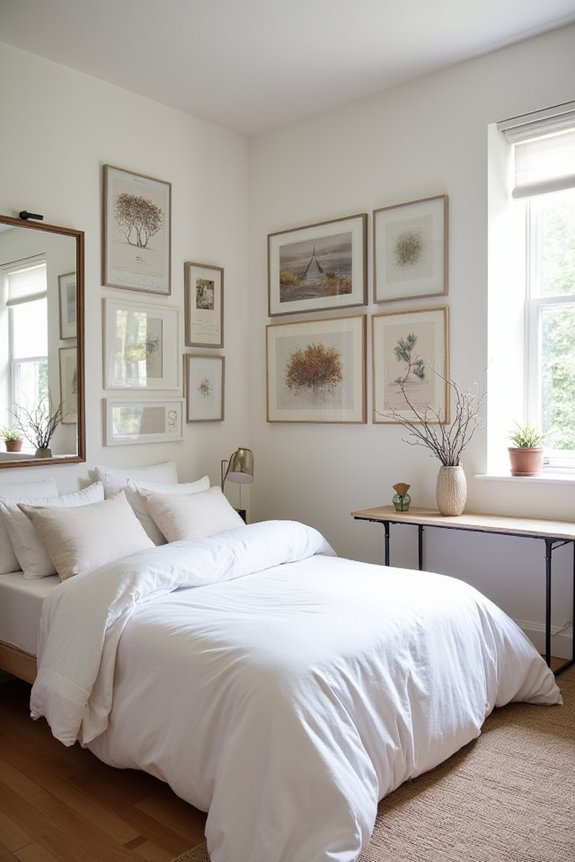
When I decorated my cramped bedroom, I hung art vertically—especially larger pieces near my bed—and the whole space felt taller and less cramped. You can create this same effect by building a gallery wall with mismatched gold and wood frames holding vintage prints, which draws your eye up the wall instead of around the small room. The trick is choosing pieces that work together and positioning them strategically so they guide your gaze upward and create the illusion that your bedroom has more height than it actually does.
Large Statement Pieces Matter
One of my favorite small-room tricks is the power of vertical thinking—and honestly, it’s almost too simple. I’ve learned that statement art changes how a room feels. When I hang a commanding piece above my bed, suddenly my ceiling doesn’t feel so close anymore. Here’s what works:
- Choose one bold art piece as your focal point
- Add supporting framed prints on adjacent walls for balance
- Mix frame styles with gold and wood finishes for visual interest
- Scale your gallery wall proportionally to your bed
The ceiling height illusion is real. Large artwork creates an upward draw that makes everything feel more spacious. I’m careful not to overcrowd, though—scale and balance matter most. When done right, your art becomes part of the room’s personality rather than clutter.
Gallery Wall Frame Styling
How’d I finally crack the code to making my cramped bedroom feel bigger? Gallery walls, my friend. I created one beside my bed using mismatched frames—gold, wood, whatever I found—paired with vintage prints. That vertical art immediately drew my eyes upward, creating the illusion of height I desperately needed.
The trick? I positioned my main piece as the anchor, then built around it with smaller framing pieces. This collected look avoided that cramped feeling I’d worried about. I kept everything off my main wall to prevent visual clutter.
What surprised me most was how this gallery wall didn’t just decorate; it changed the entire room’s mood. Suddenly, my small space felt more personal, and honestly? Noticeably larger than before.
Creating Visual Height Illusion
Ever notice how your eyes instinctively travel upward when you walk into a room with tall art on the walls? That’s how creating visual height works in your small bedroom. Strategic art arrangement changes how spacious my room actually feels.
Here’s what I do:
- Hang large statement pieces vertically above my bed to draw attention skyward
- Arrange gallery walls with mismatched gold and wood frames climbing toward the ceiling
- Position wall decor on empty surfaces away from clutter to emphasize vertical space
- Scale my artwork proportionally with surrounding furniture for balanced impact
When I stretch my gallery wall from mid-wall to near the ceiling, suddenly my bedroom feels taller. The vertical arrangement guides your gaze upward, making compact spaces seem more generous. It’s one of my preferred decorating methods.
Choose Simple White Bedding With Textured Layers for Coziness
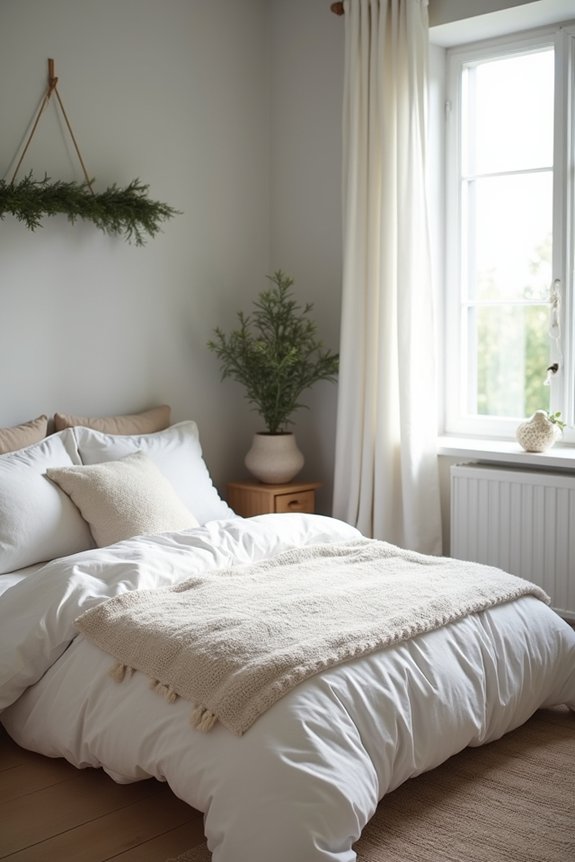
White bedding might sound boring at first, but it’s actually an effective tactic for making small bedrooms feel bigger and brighter. The key? Layering textures thoughtfully. I use a lightly textured white duvet paired with a chenille throw and fringe pillows to add comfort without cluttering the space. This approach keeps minimalism front and center while making your room feel inviting.
Here’s what I’ve learned: ditch those bulky Euro pillows. They eat up visual space and make headboards look crowded. Instead, focus on a clean, lean look that lets light bounce around freely.
The benefit of this strategy is straightforward. White reflects light beautifully, your textured layers create depth, and you’re not drowning in unnecessary stuff. Your small bedroom becomes a calm space that feels both spacious and comfortable.
Paint Furniture Dark to Add Depth Without Overwhelming the Room
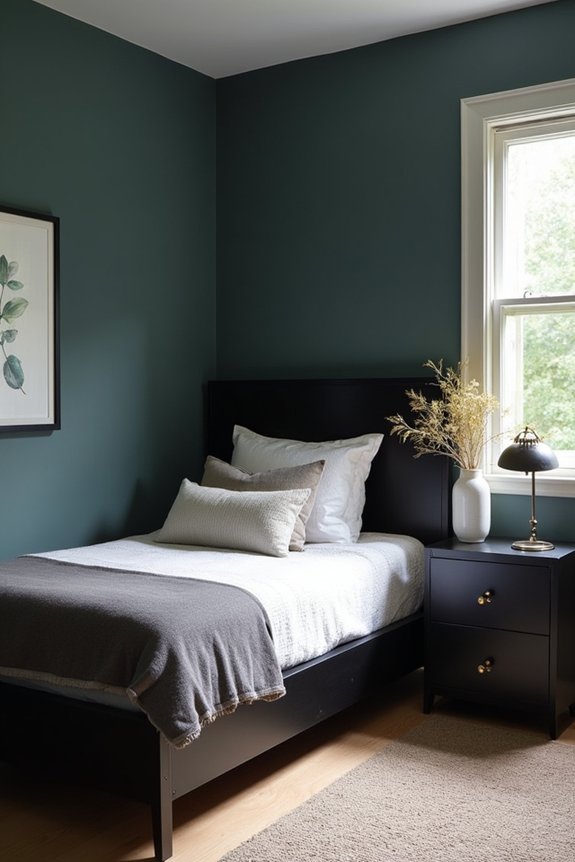
When you’re working with a small bedroom, dark furniture might seem like the last thing you’d want—I thought the same thing at first. But here’s what I discovered: painting select pieces dark actually creates depth and makes your room feel deliberate rather than cramped.
I’ve learned that strategic dark furniture works best when you:
- Choose one focal accent, like a bed frame or dresser, in charcoal or black
- Balance it with pale walls and light textiles to keep things airy
- Add reflective surfaces nearby to bounce light around
- Use a smooth, professional finish with multiple thin coats
The key is restraint. Dark contrasting accents ground your small bedroom without overwhelming it. You’re creating visual interest and sophistication—not a cave. The approach delivers results.
Select a Rug Size That Defines the Sleeping Zone
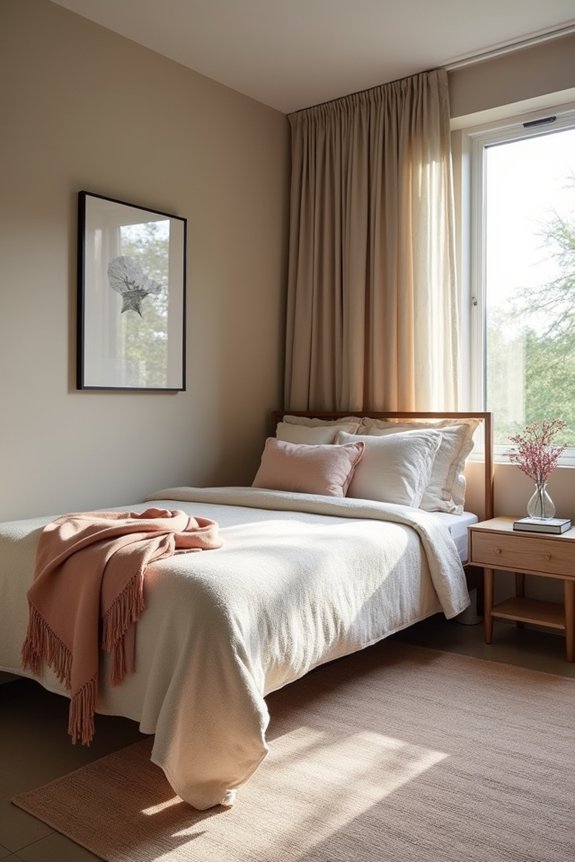
Most of us underestimate how much a rug can anchor a small bedroom—I definitely did before I started experimenting with different sizes. I learned that an 8×10 rug works well for queen beds in tight spaces, anchoring your footprint without overwhelming the room. The trick? Position it so it extends 24–30 inches beyond your bed’s sides and foot, creating a defined sleeping zone.
I’ve discovered that centering your rug under the bed shows balanced framing on both sides of your nightstands. In corner arrangements, I pull the rug toward the room’s center instead of stuffing it entirely under the bed. Layering a smaller patterned rug atop a larger solid one adds depth while keeping your room layout feeling organized and grounded. That’s when everything clicks into place.
Combine Lamps, Candles, and Sconces for Layered Lighting
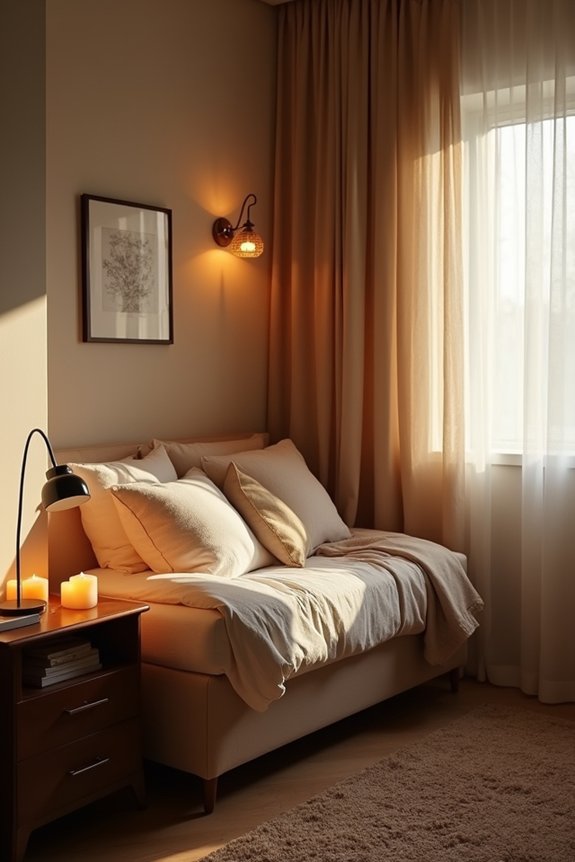
Why settle for a single overhead light when you can create a whole mood with multiple sources? Layered lighting works well in my small bedroom, making it feel more inviting than relying on one fixture. Here’s what I do:
- Place sconces on either side of my bed to free up nightstand space while creating even ambient light
- Mix warm metals like antique brass on lamps and candle holders for a cozier atmosphere
- Combine soft temperatures by pairing candles with 2700–3000K bulbs for a cohesive glow
- Install dimmer switches to shift from reading light to intimate mood lighting
This approach to bedroom lighting avoids that harsh, unwelcoming feel. My lamps, sconces, and candles work together to create depth without cluttering surfaces. The result is a space where I actually want to spend time—and it makes the room feel more intentional.
Add a Plant or Two in White Planters to Enhance Airiness
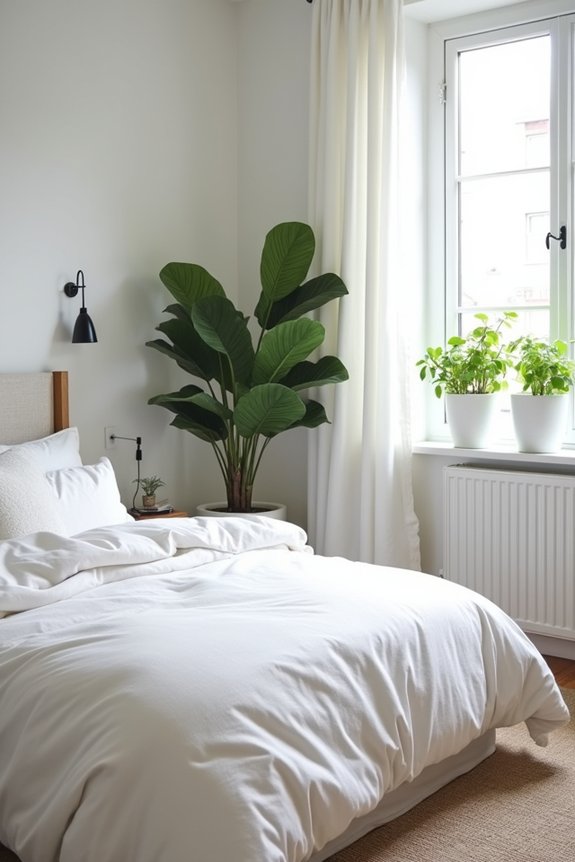
A couple of plants in white pots can help your small bedroom feel more spacious. White planters blend beautifully with walls and furniture, creating a lighter appearance. Pothos or snake plants work well with minimal decor setups and add visual interest without clutter.
Position plants on floating shelves near windows where they receive natural light. Eucalyptus stems in white planters add texture and fragrance while keeping floor space clear. Stick to two or three plants maximum—more than that will make the room feel crowded rather than open.
This approach makes a real difference in how your small bedroom feels, creating a more open and inviting environment.